You just finished calculating drip emitter spacing and mulch depth for a three-bed install, and now you’re staring at two rolls of landscape fabric on the supplier’s website: one at 3.2 oz per square yard and one at 5 oz per square yard. The price gap is meaningful — roughly $0.08 to $0.15 per square foot at wholesale in mid-2026 — and you’re wondering whether the heavier fabric is actually worth it or just a margin play. The weight rating (measured in ounces per square yard, the industry-standard way to express how dense the woven or nonwoven polypropylene material is per unit area) changes three things that matter in the real world: how easily water and air pass through the fabric, how long it holds up before UV degradation and root pressure compromise it, and how much punch-through weed pressure it can resist. This article gives you the comparison framework to make that call before you’re standing in the yard with a staple gun.
What Weight Actually Measures — and What It Doesn’t
Weight per square yard is a proxy for fiber density, not raw material thickness. A 3.2 oz nonwoven fabric and a 3.2 oz woven fabric are built differently — nonwoven is a spun-bond felt-like mat, woven is an interlocked grid of polypropylene strands — but within the same construction type, moving from 3.2 oz to 5 oz means more fiber per unit area, tighter pore geometry, and more material resisting every form of stress the install will throw at it.
Here is what weight does not directly measure: permeability (water and air flow rate). This is the trap that catches practitioners mid-project. A tighter weave from more fiber can actually reduce permeability, which matters enormously if you’re laying fabric under drip-irrigated beds where you want water from above — rainfall or surface emitters — to pass through freely. University of Maryland Extension’s document “Landscape Fabric: Pros and Cons” specifically flags that permeability is a separate spec from weight, and that degraded permeability over time is the leading reason established beds fail to drain correctly years after install.
The practical takeaway: when sourcing fabric, you need both numbers — ounces per square yard and the published flow rate or permeability rating (often listed in gallons per minute per square foot, or as a qualitative “high/medium/low” in spec sheets). Weight gives you the durability signal. Permeability gives you the hydraulic signal. Neither alone tells the full story.
Matching Weight Class to Install Condition
The three scenarios below represent the clearest decision points practitioners face. Each closes with a tier marker so you can map the recommendation to your sourcing workflow.
Seasonal and Annual-Cycle Installs
If the fabric is coming out at the end of a growing season — temporary row covers for vegetable beds, annual color bed weed suppression between spring plantings — the 3.2 oz class is the right call. You’re not asking it to last five years under decomposing hardwood mulch. You’re asking it to suppress germination for four to seven months and then exit cleanly. Lighter fabric cuts faster, anchors with fewer staples, and costs significantly less per roll at the wholesale level.
The Spruce, in its roundup “Best Landscape Fabric Options,” notes that light-duty nonwoven products perform reliably in short-cycle applications where planned replacement is part of the project scope. Fine Gardening’s practitioner-level piece “The Truth About Landscape Fabric” makes the same observation: lighter-weight products are cost-effective when the installation context genuinely does not require long-term burial under heavy organic mulch.
For budget-constrained residential jobs where a documented three-to-five-year replacement cadence replaces the expectation of permanence, 3.2 oz nonwoven is a defensible spec — only when the client understands lifecycle cost and you’ve built replacement labor into a maintenance agreement.
 product image](/images/external/27781850b4c1.jpg)
Super
$59.98
In stock on Amazon
Check price on AmazonPermanent Beds Under Organic Mulch With Moderate Weed Pressure
This is the scenario where weight class earns its premium most clearly. Organic mulch — shredded hardwood, cedar, pine bark — decomposes from the bottom up. Within 18 to 36 months, the lower inch of a 3-inch mulch layer is actively composting directly on top of your weed barrier. That decomposing layer becomes a near-ideal germination medium for weed seeds blown in from above. A 3.2 oz fabric under mechanical stress from decomposing material above will allow fibrous weed roots to begin penetrating the weave as the pore geometry loosens.
Penn State Extension’s publication “Mulches for Landscaping” identifies this decomposition-driven failure mode as the most common complaint from homeowners who spec light fabric under wood mulch. A 5 oz woven polypropylene product resists root penetration longer because the tighter fiber geometry gives roots fewer low-resistance pathways through the material.
This Old House, in its “Best Landscape Fabric” review, reports that 5 oz and heavier products consistently show functional lifespans of eight to fifteen years under organic mulch when properly installed with overlapped seams and adequate staple spacing, compared to three to six years for 3.2 oz products in the same conditions. On a 1,000 square foot install, the $80 to $150 upfront premium for the heavier product typically costs less than a single fabric-removal-and-reinstall event, which — in complex beds with established perennials rooted through the fabric — frequently runs $300 or more in labor alone.
 product image](/images/external/9d44aa85c532.jpg)
ECOgardener
$60.99
In stock on Amazon
Check price on AmazonHigh-Foot-Traffic Zones, Path Underlayment, and Aggressive Rhizome Environments
Decomposed granite paths, crusher-fine walkways, and stepping-stone installations all impose repetitive mechanical stress through the surface material. Every footfall compresses the aggregate, transferring shear load to the fabric beneath. Lighter fabric delaminates or tears at staple points within a few seasons. The 5 oz class — or heavier commercial-grade products at 6 oz and above — handles this loading better by simple virtue of having more fiber to absorb and distribute stress before failure.
For aggressive weed pressure environments involving nutsedge, bindweed, or Bermuda grass rhizomes, construction type matters more than weight alone — woven, not nonwoven, is the right starting point for rhizome resistance. But within woven products, higher weight extends the time before rhizomes find mechanical pathways through the weave. University of Maryland Extension’s “Landscape Fabric: Pros and Cons” is explicit that no fabric stops aggressive rhizomatous weeds indefinitely, but heavier woven products meaningfully extend the suppression window before intervention is required.
For path underlayment and high-rhizome-pressure beds, treat 5 oz woven as the floor, not the ceiling. The longevity math and mechanical-stress resistance both point the same direction.
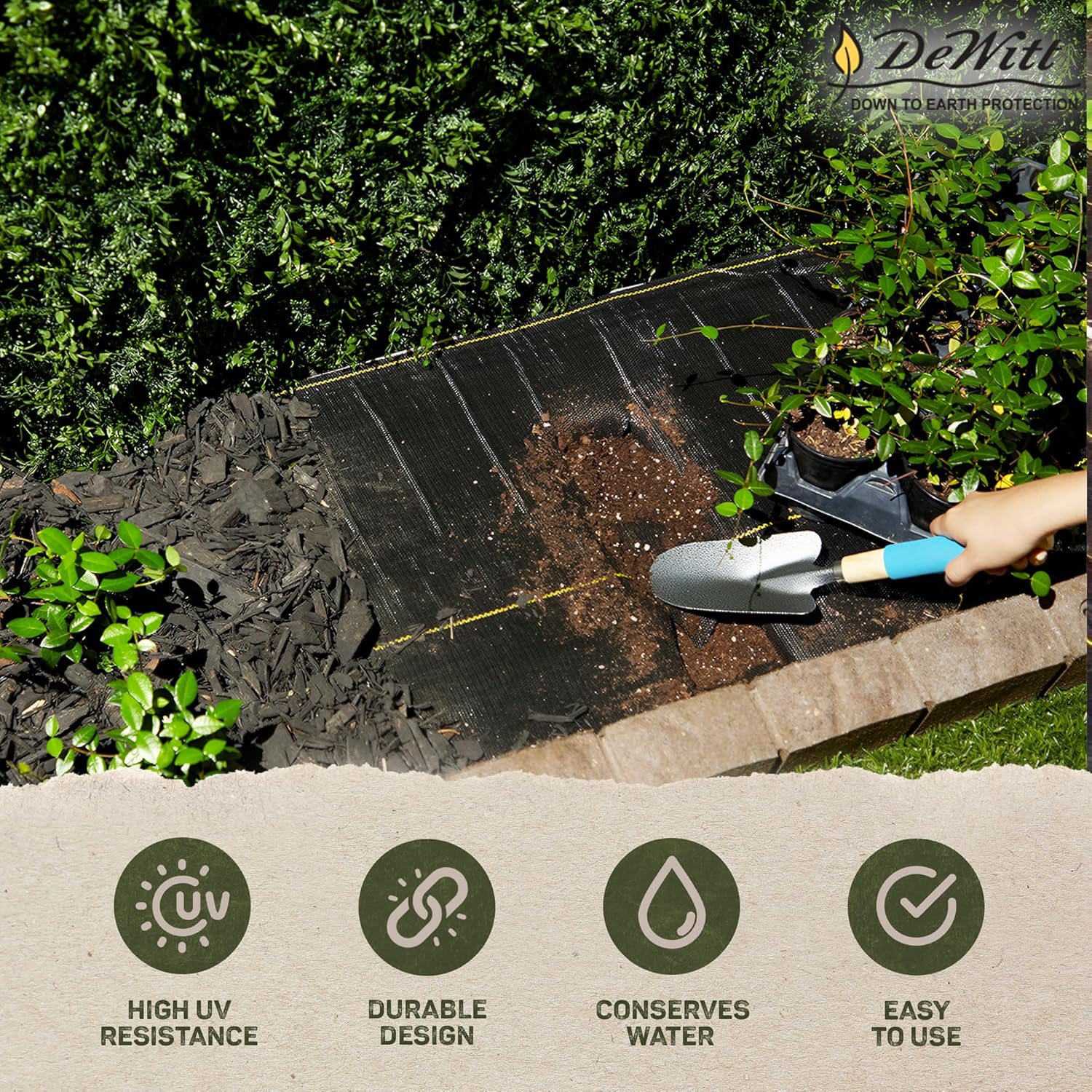
Dewitt
$129.99
In stock on Amazon
Check price on AmazonThe Permeability Tradeoff: What the Numbers Look Like
The hydraulic math matters for drip-system specifiers. The table below maps weight class and construction type to typical published flow rates, with practical implications for each.
| Weight & Construction | Typical Flow Rate | Practical Water Passage | Super — $59.98 |
|---|---|---|---|
| 3.2 oz nonwoven | 100–140 gal/min/sq ft | High — rainfall and surface irrigation pass through freely | Super — $59.98 |
| 3.2 oz woven | 40–80 gal/min/sq ft | Moderate — adequate for most drip layouts | Super — $59.98 |
| 5 oz woven | 20–50 gal/min/sq ft | Moderate-low — acceptable above drip emitters; problematic for surface-irrigation reliance | ECOgardener — $60.99 |
| 5 oz nonwoven | 60–100 gal/min/sq ft | Moderate-high — better hydraulic performance than woven at the same weight | ECOgardener — $60.99 |
| 6 oz+ woven (commercial) | 15–35 gal/min/sq ft | Low — suited for sub-drip installs and path underlayment, not surface irrigation | Dewitt — $129.99 |
Flow rate ranges drawn from published manufacturer spec sheets and The Spruce’s permeability comparison in “Best Landscape Fabric Options.” Actual site performance varies with sediment loading and mulch depth.
The decision implication is direct. If you’re laying fabric over drip tubing and emitters are below the fabric delivering water directly to the root zone, permeability of the fabric matters less — the water is already where you need it. If you’re relying on rainfall or overhead spray to penetrate fabric from above, a 5 oz woven product’s tighter pore geometry can meaningfully restrict infiltration, particularly once mulch sediment begins loading the fabric surface after six to twelve months. In that scenario, 5 oz nonwoven is the compromise product: it gives you the durability signal of higher weight without the hydraulic penalty of woven construction at the same density.
The Longevity Math: Cost Per Year of Service
The price gap between 3.2 oz and 5 oz fabric at wholesale in mid-2026 runs approximately $0.08 to $0.15 per square foot depending on roll size and supplier. On a 1,000 square foot install, that’s an $80 to $150 upfront premium for the heavier product.
Consider a straightforward failure-cost scenario: a 3.2 oz install fails at year four and requires full removal and reinstallation. At a modest $0.30 per square foot for fabric-and-staple removal on a complex planted bed, removal alone costs $300. Add replacement fabric and staples at roughly $320, and year-four remediation totals approximately $620. The 5 oz product that runs eight to twelve years without replacement cost $150 more upfront and nothing at year four.
This math tightens on simple, accessible rectangular beds with minimal plantings, where removal labor drops and the cost-per-year comparison narrows. But for complex planting beds with established perennials, trees, or shrubs rooted through the fabric, removal is rarely simple. The year-four remediation cost in those conditions almost always exceeds the upfront premium for the heavier product — often by a factor of three or four when crew time is fully loaded.
The practical rule: if you expect the bed to exist in its current form for more than five years, the 5 oz premium pays for itself. If you’re building in replacement as part of a documented maintenance contract, 3.2 oz is defensible and the math supports it — provided the client is informed.
Decision Rules: If X, Then Y
Seasonal or annual-cycle install: Specify 3.2 oz nonwoven. Optimize for ease of removal and per-roll cost, not longevity. Super — $59.98
Permanent beds under organic mulch, moderate weed pressure: Specify 5 oz woven polypropylene. Longevity math and root-resistance case are both clear. ECOgardener — $60.99
Path underlayment or high-foot-traffic zone: Specify 5 oz woven minimum; consider 6 oz commercial-grade for heavy aggregate installs. Mechanical stress under aggregate is the primary failure mode. Dewitt — $129.99
Install above drip emitters, sub-fabric water delivery: You can move down to 3.2 oz woven without sacrificing hydraulic performance. Permeability constraint matters less when water delivery is already below the fabric.
Install relying on surface rainfall or overhead irrigation: Test the manufacturer’s published flow rate before committing to 5 oz woven. If permeability is a concern, 5 oz nonwoven delivers durability without the hydraulic penalty of woven construction at the same weight.
Budget-constrained residential job with planned replacement cadence: 3.2 oz is defensible only when documented replacement timing and labor cost are built into the client agreement. Don’t spec light fabric and leave the client expecting permanent suppression — that is the conversation that erodes referrals.
The ounce rating on a roll of landscape fabric is a proxy for a set of performance tradeoffs that play out over years, not days. Matching the spec to the install condition is where practitioners separate themselves from whoever grabbed the cheapest roll on the shelf. The 1.8 oz difference between 3.2 and 5 oz is a longevity multiplier — and in established beds, labor is always the expensive variable.