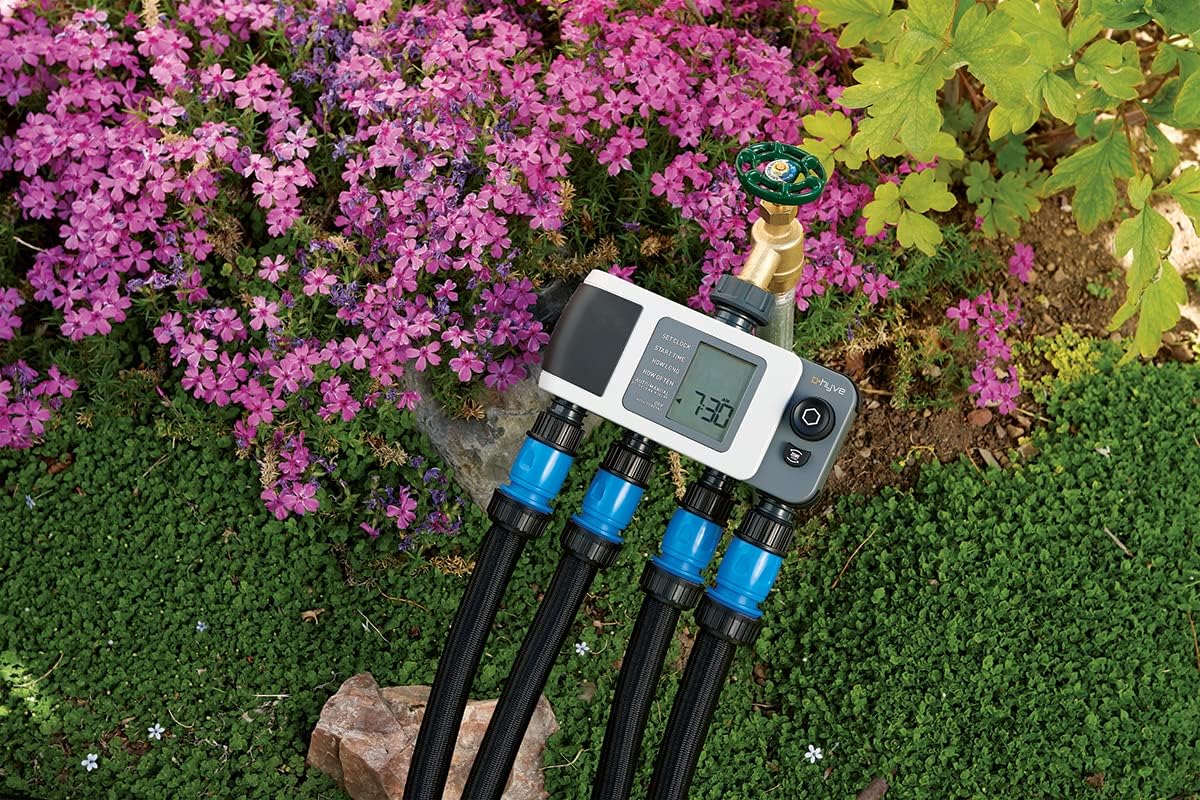
You’re mid-spec on a three-zone drip layout — pressure-compensating emitters on the perennials, a separate zone for the raised beds, and a third running soaker line along the fence border — and you’re about to order the controller when you realize you have no idea whether the unit you picked will actually show up inside Apple Home, Google Home, or Amazon Alexa. Not “technically compatible if you install the skill.” Actually show up, respond to voice commands, and let you trigger zones without pulling out a separate app. That gap between marketed as smart and works in your ecosystem is where a lot of otherwise solid irrigation builds get stuck. This guide is written for the person who already understands what a multi-zone drip system is but hasn’t yet decoded which controller protocol does what, and why the platform you already live in should drive the purchase decision before anything else.
Why Ecosystem First Is the Right Decision Frame
The instinct is to search for the best-reviewed smart controller, then check compatibility afterward. Reverse that. Here’s why it matters at the practitioner level.
Apple HomeKit, Google Home, and Amazon Alexa are not interchangeable surfaces for the same device. They use different communication layers, different authentication flows, and different permission models for local versus cloud control. A controller that works beautifully through the Rachio app but only integrates with Alexa via a cloud skill — meaning every command routes through Amazon’s servers before reaching your Wi-Fi router before reaching the device — has a meaningfully different reliability profile than a controller with native HomeKit support using the HAP (HomeKit Accessory Protocol) handshake, which can operate locally even when your internet is down.
For a homeowner watering a few raised beds, that distinction is minor. For a property manager running a six-zone system on a client install, or a landscape designer whose client calls at 7 AM because a zone didn’t cycle and a new sod section looks dry, local-control reliability is a spec that belongs in your proposal documentation.
The three integration tiers you’ll encounter in the market:
- Native / certified integration — the device carries the Works with HomeKit badge, Google Home certification, or official Alexa skill with full zone-level control. No third-party bridge required.
- Bridge-dependent integration — the device works with your platform, but only through a hub (SmartThings, Home Assistant, etc.) or a secondary cloud relay. Adds latency and a failure point.
- App-only with voice shortcut — marketed as “voice compatible” but only through a saved Alexa routine or Google Assistant shortcut. You can say “water the garden” and it fires a pre-set scene; you cannot say “run zone 2 for 12 minutes” dynamically.
Wirecutter’s coverage of smart sprinkler controllers notes that this distinction — native integration versus shortcut-based voice control — is one of the most consistently misunderstood purchase points in the category, and that reviewers who feel burned by “smart” controllers that don’t integrate cleanly almost always bought on tier 3 while expecting tier 1 behavior.
HomeKit Compatibility: The Highest Bar, the Tightest Set of Approved Options
If your household is already running Apple Home — lights, locks, thermostat, doorbell — HomeKit irrigation control is genuinely useful. You can incorporate watering into automations (“when I leave home, run zone 1 for 10 minutes if soil sensor reads dry”), see zone status in the Home app alongside everything else, and control it from the same interface without switching apps.
The tradeoff: Apple’s MFi (Made for iPhone/iPad) certification process is demanding, and as of mid-2026, the field of natively HomeKit-certified irrigation controllers remains narrow relative to the Alexa and Google Home markets. The most consistently cited option in this tier — acknowledged by both Wirecutter and This Old House in their most recent controller roundups — is the Rachio 3 via its HomeKit integration, though it’s worth noting that Rachio’s HomeKit support is delivered through a software bridge layer rather than direct HAP hardware certification, which means it depends on the Rachio cloud remaining in the loop for initial pairing. Orbit’s B-hyve line has offered HomeKit support in its newer generations; aggregated owner reviews suggest the integration is functional but less polished than Rachio’s in terms of Home app tile layout and Siri responsiveness.
For buyers who want true local HomeKit control without cloud dependency, the more robust path — if you’re already running a Home Assistant instance or a dedicated Apple TV/HomePod as a home hub — is to use a controller with a local API and map it through HomeKit via Homebridge. That’s a prosumer-tier setup that adds configuration overhead but gives you genuine local-network control.
If HomeKit is your ecosystem: Confirm that the controller’s HomeKit support is listed on Apple’s official MFi/Works with Apple Home database before purchasing, not just on the manufacturer’s marketing page. The two lists do not always match.
Alexa and Google Home: Broader Compatibility, More Variable Depth
The Alexa and Google Home ecosystems cast a wider net. Most major smart irrigation brands — Rachio, Orbit B-hyve, RainBird’s smart-enabled line, Hunter’s Hydrawise platform — offer official Alexa skills and Google Home actions. But “official skill” covers a range of functional depth.
By the numbers:
| Platform | Dynamic zone-level voice control | Schedule override by voice | Rain skip by voice | Local fallback if internet down |
|---|---|---|---|---|
| HomeKit (native certified) | Yes | Yes | Limited | Yes (with home hub) |
| Alexa (full-featured skill) | Yes (Rachio, B-hyve) | Yes | No | No |
| Google Home (native action) | Yes (Rachio, Hydrawise) | Yes | No | No |
| Alexa/Google (shortcut-only) | No | No | No | No |
The Hunter Hydrawise platform is worth flagging specifically for the prosumer and landscape-pro audience. Hydrawise’s Google Home integration — documented in Hunter Industries’ own Hydrawise compatibility documentation — supports zone-level control and schedule management at a depth that matches what Rachio offers on Alexa. Hydrawise is also notable for its contractor-tier remote management dashboard, which lets a landscape professional manage multiple client accounts from a single login. This Old House’s controller reviews have highlighted Hydrawise as the go-to recommendation for multi-property managers who need to standardize on a single platform across installs.
For Alexa specifically: the Rachio 3’s Alexa integration is consistently cited across aggregated reviews as the most natural-language-responsive in the category. Owners report being able to say “Alexa, tell Rachio to run the front yard for 15 minutes” without pre-configuring a routine, which is the tier 1 behavior described above. Orbit B-hyve’s Alexa skill functions well for schedule management and manual zone runs but receives less consistent marks for natural-language flexibility in longer-run owner review patterns.
A practical note for Google Home users in 2026: Google’s continued investment in the Matter protocol (a cross-platform smart-home standard backed by Google, Apple, Amazon, and others) has created a new variable in the irrigation controller market. As of this writing, no major irrigation controller has shipped with native Matter support, but Rachio and several other vendors have publicly committed to Matter certification in upcoming firmware or hardware revisions. Fine Gardening’s drip irrigation overview and BHG’s irrigation setup guide both note that the “wait for Matter” calculus is worth a short pause for buyers not under time pressure — a Matter-certified controller will, in theory, work natively across all three ecosystems simultaneously.
Matching Controller to System Architecture: The Variables That Change the Decision
Ecosystem compatibility is the first filter. These are the second-order specs that matter once you’ve narrowed by platform.
Zone count vs. flow math. A smart hose timer (single-zone, attaches directly to an outdoor spigot) and a multi-zone smart controller (wired to a valve manifold, typically 4–16 zones, requires either battery or 24VAC power) are different product categories with different smart-home integration profiles. Single-zone hose timers like the Orbit B-hyve single-zone or the Rachio hose timer tend to have lighter ecosystem integrations — functional but fewer automation triggers. Multi-zone wired controllers are where the full smart-home integration depth (zone-level voice control, soil-sensor integration, weather intelligence) actually lives. If you’re speccing a serious drip layout — pressure regulator, filter, manifold with individual zone shutoffs — you want a multi-zone wired controller, not a hose timer.
Weather intelligence and local data sourcing. Both Rachio and Hydrawise use hyperlocal weather data (from Weather Underground PWS networks or NOAA) to calculate evapotranspiration (ET) — the rate at which soil loses moisture to heat and wind — and adjust run times automatically. This is the feature that separates a smart controller from a timer with a phone app. For property managers billing on water efficiency, ET-based scheduling is a documentable outcome: Rachio has published internal customer data showing 30–50% water use reduction against fixed-schedule watering, though those figures come from Rachio’s own reporting rather than independent third-party measurement.
App quality and long-term vendor stability. This is a harder variable to quantify but worth naming explicitly. Several smart irrigation brands from 2019–2022 have since pivoted, discontinued hardware, or degraded app support. Orbit’s B-hyve line has seen periods of inconsistent app reviews on both iOS and Android; the current generation (Gen 2 hardware) has stabilized according to aggregated App Store review trends as of early 2026, but the pattern is a reason to weigh vendor track record alongside current-generation specs.
The Decision Rule
Here’s the frame that should govern your final call:
If you’re in an Apple Home household and want irrigation to live natively in that environment: Rachio 3 with HomeKit integration is the current best-available option, with the understanding that its HomeKit path is cloud-assisted at pairing. Budget prosumer alternative: Orbit B-hyve Pro with HomeKit, acknowledged as functional if less polished.
If you’re in an Alexa-primary household: Rachio 3 delivers the deepest natural-language integration. If you’re managing multiple properties and need contractor dashboard access, Hunter Hydrawise on Alexa is the more scalable architecture.
If you’re in a Google Home household: Rachio and Hydrawise both offer solid Google Home actions. Hydrawise edges ahead for multi-property prosumer use cases due to its contractor account structure.
If you’re building a new system and not locked into any ecosystem yet: Hold briefly for Matter-certified hardware if your project timeline allows a 6–12 month window. If you need to install now, Rachio 3 is the most cross-platform-friendly option currently available, with the broadest ecosystem support and the deepest owner-reported satisfaction across aggregated review sources.
If you’re speccing a single raised-bed setup and just want reliable scheduled watering with basic voice control: A smart hose timer (Orbit B-hyve single-zone or Rachio hose timer, both available at entry-level price points) handles the job without the complexity of a wired manifold controller. Don’t overbuild the controller for a simple single-zone drip layout — the integration depth you’re paying for in a full multi-zone unit goes unused.
The smart-home irrigation market is still sorting out its platform loyalties. The controllers with the clearest roadmap — Matter support, active firmware development, and established contractor tiers — are the ones worth speccing into installs you’ll be managing for clients two or three seasons from now.