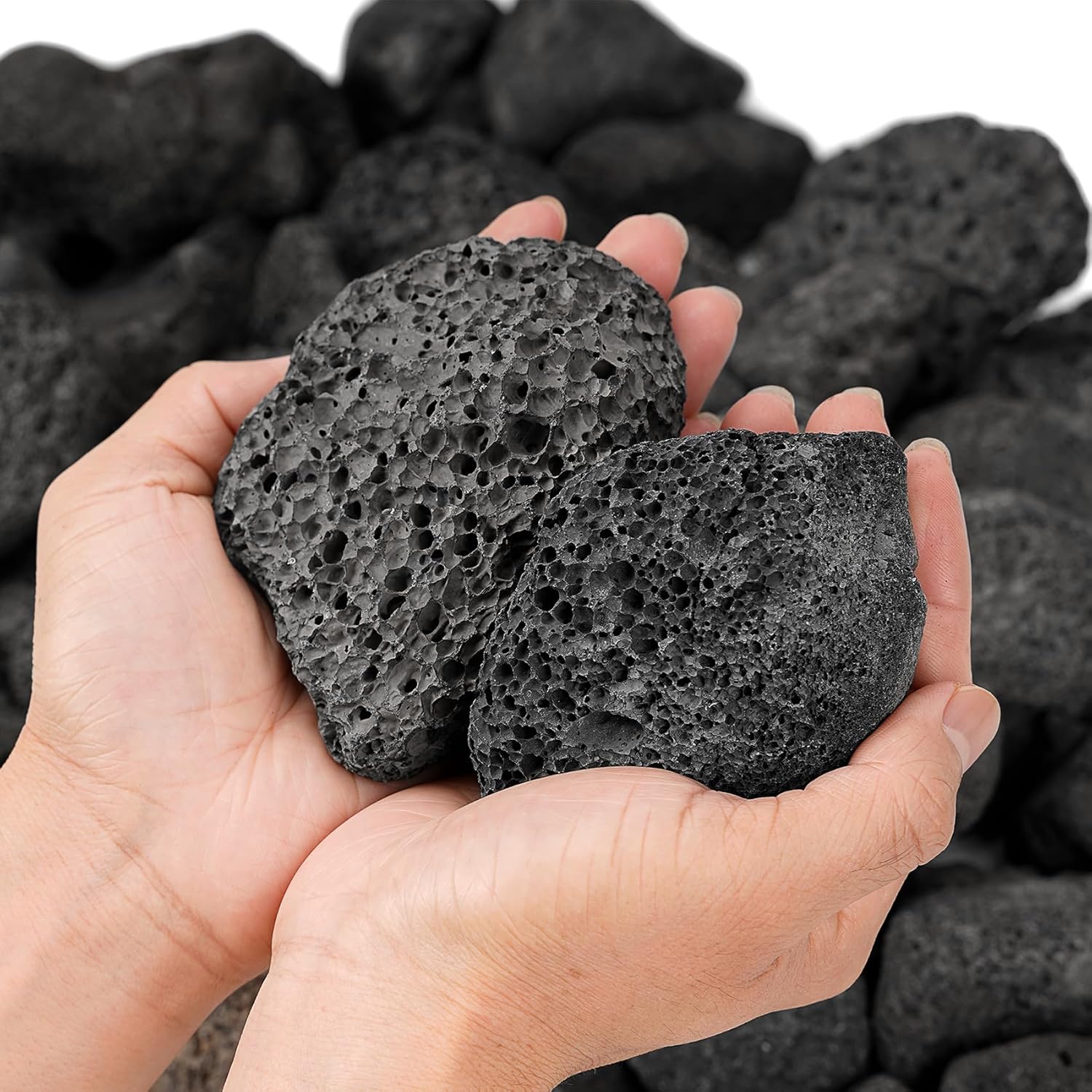
You just ordered a 40-pound bag of “lava rock” for a client’s gas fire pit installation, it arrives, and the pieces are the size of gravel chips — nowhere near the chunky, dramatic stones you pictured. Or the reverse: you spec’d lava rock as a top-dressing mulch for a succulent border, and the bag that shows up is full of palm-sized chunks that look like they belong in a fire bowl. Same product name, completely different product. Lava rock — vesicular basalt that has been quarried, crushed or sorted, and sized into specific ranges — is sold across two almost entirely separate markets: fire pit/hardscape use and horticultural/landscaping use. The grading conventions, size ranges, density expectations, and price tiers between those markets barely overlap. If you’re sourcing for a client build right now, this guide gives you the exact framework to specify correctly the first time.
Why the Grades Diverge: What Each Application Actually Demands
The confusion starts because both product categories come from the same raw material — vesicular basalt, the porous, lightweight volcanic rock that ranges in color from brick red to near-black depending on iron-oxide content and regional origin. But the job each grade is doing is so different that the processing specs have drifted almost entirely apart.
Fire Pit Grade: Thermal Performance First
Fire pit lava rock is performing a thermal and aesthetic function. In a gas fire pit — the dominant application in the residential and commercial hardscape market — the rock sits above a burner manifold and does two things: it disperses the flame so it looks natural rather than like a single plume, and it radiates stored heat after the burner cycles. To do that reliably, the rock needs to be large enough that it won’t fall into or block burner ports, dense and structurally intact enough to survive repeated thermal cycling without fracturing, and low in trapped moisture — because moisture inside a porous rock that’s suddenly exposed to high flame temperatures will flash to steam and crack or even shatter the piece.
This Old House, in their published guide “All About Fire Pit Safety,” explicitly calls out the moisture-fracture risk and recommends allowing any lava rock to fully dry before its first fire, even if it looks dry externally. Manufacturers of propane and natural gas fire pit inserts typically specify a 1”–3” lava rock grade in their installation manuals, with some premium linear burner systems calling for an even tighter 0.75”–1.5” range for more precise flame patterning.
 product image](/images/external/c0094d32dc80.jpg)
NUPICK
$9.99
In stock on Amazon
Check price on AmazonHorticultural Grade: Soil Physics and Root-Zone Function
Horticultural lava rock is performing a soil-physics function. Fine Gardening, in their piece “Using Gravel and Stone Mulch,” notes that in planting contexts, lava rock is valued for its extraordinary porosity — the same air pockets that make it look dramatic also allow it to hold moisture in humid conditions and drain rapidly in wet ones, making it ideal for succulents, cacti, alpine plants, and any situation where you want to improve soil structure without adding organic matter that will decompose. For those applications, you typically want smaller particle sizes (0.25”–0.75” for top-dressing, 0.5”–1” for soil amendment mixing) and consistent particle sizing so water and air move evenly through the root zone.
Penn State Extension, in their publication “Mulching Landscape Plants,” notes that particle size directly controls how much pore space a mulch layer creates — smaller rock creates more contact points, larger rock creates bigger individual voids. For most horticultural use, the goal is maximizing fine pore space around roots, which the smaller lava rock grades achieve far better than fire pit grades.
 product image](/images/external/7037a584dde0.jpg)
Skyflame
$26.99
In stock on Amazon
Check price on AmazonThe Double-Duty Trap: Why One Grade Can’t Serve Both Jobs
If your client wants the rock to do double duty — visible mulch in a planting bed that surrounds a fire feature — you’re going to need two separate products. There is no single grade that threads this needle cleanly. Trying to use fire pit rock as horticultural mulch means oversized pieces with poor root-zone coverage; trying to use horticultural fine rock in a gas fire pit means burner-port blockage risk and poor flame distribution. The 15-minute conversation that clarifies this with a client upfront is worth far more than the callback after an install goes sideways. Source the fire pit media and the planting bed top-dressing separately, and spec them to their respective applications.

Black MD
$49.99
In stock on Amazon
Check price on AmazonSize and Weight: The Specification Numbers That Actually Matter
Here’s where practitioners make the costly mistake: assuming “lava rock” on a supplier’s product page means a consistent thing across listings. It doesn’t. Here’s a working reference grid:
Lava rock grade comparison:
| Grade | Typical Size Range | Bulk Density (approx.) | Primary Application | Tier |
|---|---|---|---|---|
| Fine horticultural | 0.25”–0.5” | 35–45 lbs/cu ft | Soil amendment, cactus mix top-dressing | NUPICK — $9.99 |
| Medium horticultural | 0.5”–1” | 40–50 lbs/cu ft | Border mulch, raised bed drainage layer | Skyflame — $26.99 |
| Fire pit / coarse landscape | 1”–3” | 45–55 lbs/cu ft | Gas fire pit media, decorative hardscape rock | Skyflame — $26.99 |
| Large fire pit / boulderette | 3”–6” | 50–60 lbs/cu ft | Wood-burning fire pits, large boulder accents | Black MD — $49.99 |
Bulk density ranges are approximate and vary by origin quarry and moisture content. Always request a data sheet for large orders.
Weight math matters enormously when you’re doing a volume-to-bag conversion for a client quote. University of Maryland Extension, in their resource “Soil Amendments and Mulches,” notes that lava rock runs significantly lighter than comparable mineral materials like pea gravel or decomposed granite — roughly 30–40% lighter by volume than standard pea gravel — which is why it’s often preferred for rooftop planters and elevated beds where structural load limits apply. However, “lighter than gravel” still means 45–55 lbs per cubic foot. If you’re quoting a 4”–6” mulch layer across 200 square feet of planting bed, you’re looking at roughly 400–600 lbs of rock minimum. Miscalculate the grade density and your bag count is wrong before you’ve placed the order.
The Sourcing Problem: Why “Lava Rock” on a Product Page Is Not a Specification
The Spruce, in their aggregated review “Best Lava Rocks for Fire Pits,” notes that consumer-facing bag labeling is wildly inconsistent — the same product may be labeled “fire pit lava rock” by a big-box retailer and “landscape lava rock” by a hardscape specialty supplier, with no meaningful difference in what’s inside the bag. For one-off homeowner purchases that’s mostly harmless. For a practitioner sourcing 20 or more bags for a client install, it’s a real problem.
Three things to check before you confirm an order:
1. Request the actual size range in inches or millimeters, not a grade name. “Medium” means nothing. “0.5”–1.5” nominal” means something. Any reputable wholesale supplier can give you this; if they can’t, that’s diagnostic information about the supplier.
2. Ask whether the product is washed and dried. This matters most for fire pit applications. Quarry-direct rock often retains fine dust and surface moisture. For gas fire pit installs, washed and pre-dried stock is the correct spec. For horticultural use, a small amount of fine dust is mostly harmless — and may even provide minor mineral nutrition to the soil — but heavily dusty rock will temporarily cloud irrigation water and can clog drip emitters if you’re doing a combined drip-plus-rock-mulch install.
3. Confirm color consistency across lot sizes. Lava rock color varies by quarry origin — Hawaiian-sourced rock tends toward darker red-black, while Mexican and Pacific Northwest sources often run redder or more orange-toned. If a designer client is matching the rock to existing hardscape elements or a planter finish, request a color-match sample from the same production lot before full-quantity delivery. Installers who skip this step and discover mid-install that their second pallet is noticeably different in tone from the first are having a very bad day on the client’s time.
The If/Then Decision Frame: Which Grade for Which Job
This is the part that matters when you’re standing in front of a supplier portal or spec sheet with a purchase decision pending.
If the application is a gas or propane fire pit insert: Specify 1”–3” washed lava rock, confirmed dry, from a supplier that can document the size range. Avoid anything finer than 0.75” — small particles will fall into burner ports on most standard insert designs. This Old House’s fire pit safety guidance specifically warns against using very fine or dusty aggregate in gas applications because residue accumulates on burner components and can affect flame pattern over time. Budget-tier 40-pound bags from home centers are adequate for a single fire bowl; for a built-in fire pit table or a linear burner longer than 36 inches, source from a hardscape wholesale supplier with consistent lot sizing.
If the application is a wood-burning fire pit: You have more flexibility on size — 1”–4” works well, and the larger grades are preferable because they’re less likely to be displaced by log repositioning. Moisture content matters more here, not less. Wood fire pits reach higher temperatures and more irregular heat distribution than gas-fueled units, which increases fracture risk if the rock retains moisture. This Old House and most manufacturer guidance recommends allowing new lava rock to warm slowly during the first several fires rather than starting at full burn.
If the application is horticultural mulch or top-dressing: Specify 0.5”–1” for most planting contexts. Go finer (0.25”–0.5”) only if you’re top-dressing a cactus or succulent arrangement where the visual texture of individual pieces matters aesthetically. Penn State Extension’s “Mulching Landscape Plants” notes that anything coarser than 1.5” in a planting bed context starts to create large void pockets that can dry out surface root zones unevenly — acceptable in a dry-climate xeriscape design, but problematic in a mixed planting bed that receives supplemental irrigation.
If the application is a drainage layer under a raised bed: The medium horticultural grade (0.5”–1”) is the practical sweet spot. The goal here is not aesthetic — it’s preventing soil migration into the drainage layer and ensuring water moves freely. Lava rock performs well here compared to pea gravel because its irregular surface texture resists soil particle migration better than smooth-surfaced round gravel, a characteristic noted in University of Maryland Extension’s “Soil Amendments and Mulches” resource on drainage layer construction.
The rock is cheap. The grade error is expensive. Specify the size range in writing before any wholesale order ships, and you will not have this problem twice.