Imagine you’re specifying five elevated planter boxes for a client’s new accessible kitchen garden — a patio redesign where the homeowner uses a wheelchair and wants to grow herbs without assistance. You’ve already narrowed it down to three products, but then you notice the weight ratings differ by nearly 200 pounds per unit, the drainage hole configurations look completely different, and the listed heights range from 24 inches to 36 inches. Which one actually meets ADA reach-range guidelines — the federal accessibility standards that define how high a surface can be before a seated person can no longer comfortably use it? Which one won’t warp when filled with wet soil? And which one is going to crack a patio slab if you’re not careful?
Elevated planter boxes — meaning planters mounted on fixed legs or a raised frame rather than sitting flush on the ground — solve real problems: they prevent pooled water from rotting a bottom panel, eliminate ground-level kneeling, and make gardening genuinely accessible to people with mobility limitations. But the design variables that separate a solid specification from an expensive mistake are tighter than the marketing copy usually admits. This guide walks through drainage architecture, structural weight math, and accessibility height standards, then maps each to a budget, mid-tier, and premium buying decision so you can make the call confidently.
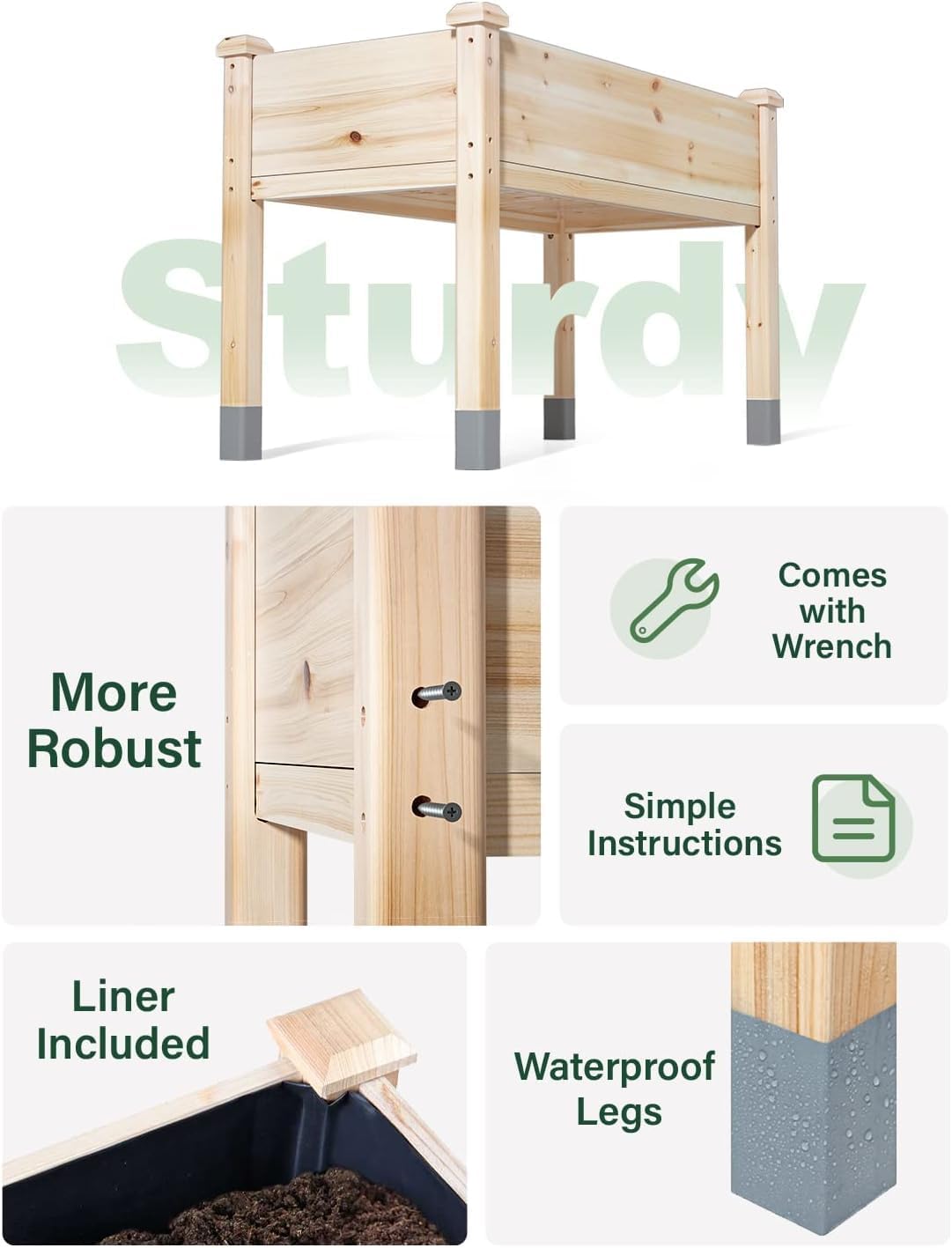
| EDITOR'S PICK[MIXC 331 lb Capacity Wooden Rai…](https://www.amazon.com/dp/B0DPCFP45D?tag=greenflower20-20) | Mid-tier31.5" Tall Raised Garden Bed wi… | Budget pick[DIIYIV Galvanized Raised Garden…](https://www.amazon.com/dp/B0FNRFZMLX?tag=greenflower20-20) | |
|---|---|---|---|
| Capacity | 331 lb | 400 lbs | 350lb |
| Material | Wood | Metal | Galvanized |
| Dimensions | 48×24×31 in | 31.5" × 15.7" | 48×24×30in |
| Wheels included | — | ✓ | — |
| Storage shelf | — | ✓ | — |
| Price | $79.99 | $69.82 | $44.09 |
| See on Amazon → | See on Amazon → | See on Amazon → |
Drainage Design: Why the Bottom Panel Is the Whole Story
Most ground-level planters drain through holes punched in a flat bottom. Elevated planters can do the same — but the leg-and-frame structure creates an opportunity for something better, and the manufacturers who take that opportunity seriously produce measurably better results over a growing season.
Slatted or Open-Bottom Frames
Slatted or open-bottom frames are the gold standard for elevated planters. Instead of a solid panel with drain holes, the base consists of parallel slats or a hardware cloth insert, leaving 30–60% of the floor area open. Cornell University Cooperative Extension’s raised bed gardening fact sheet, published through the Cornell Garden-Based Learning program, specifically notes that unrestricted bottom drainage is the single most effective strategy for preventing anaerobic — oxygen-depleted, root-suffocating — soil conditions in contained growing environments. Slatted bottoms achieve this without requiring the gardener to manage drainage intervals.
This configuration is most commonly found at the mid-tier and premium price points. Budget-category elevated planters rarely invest in slatted base engineering, which is one of the clearest functional dividing lines across the market.
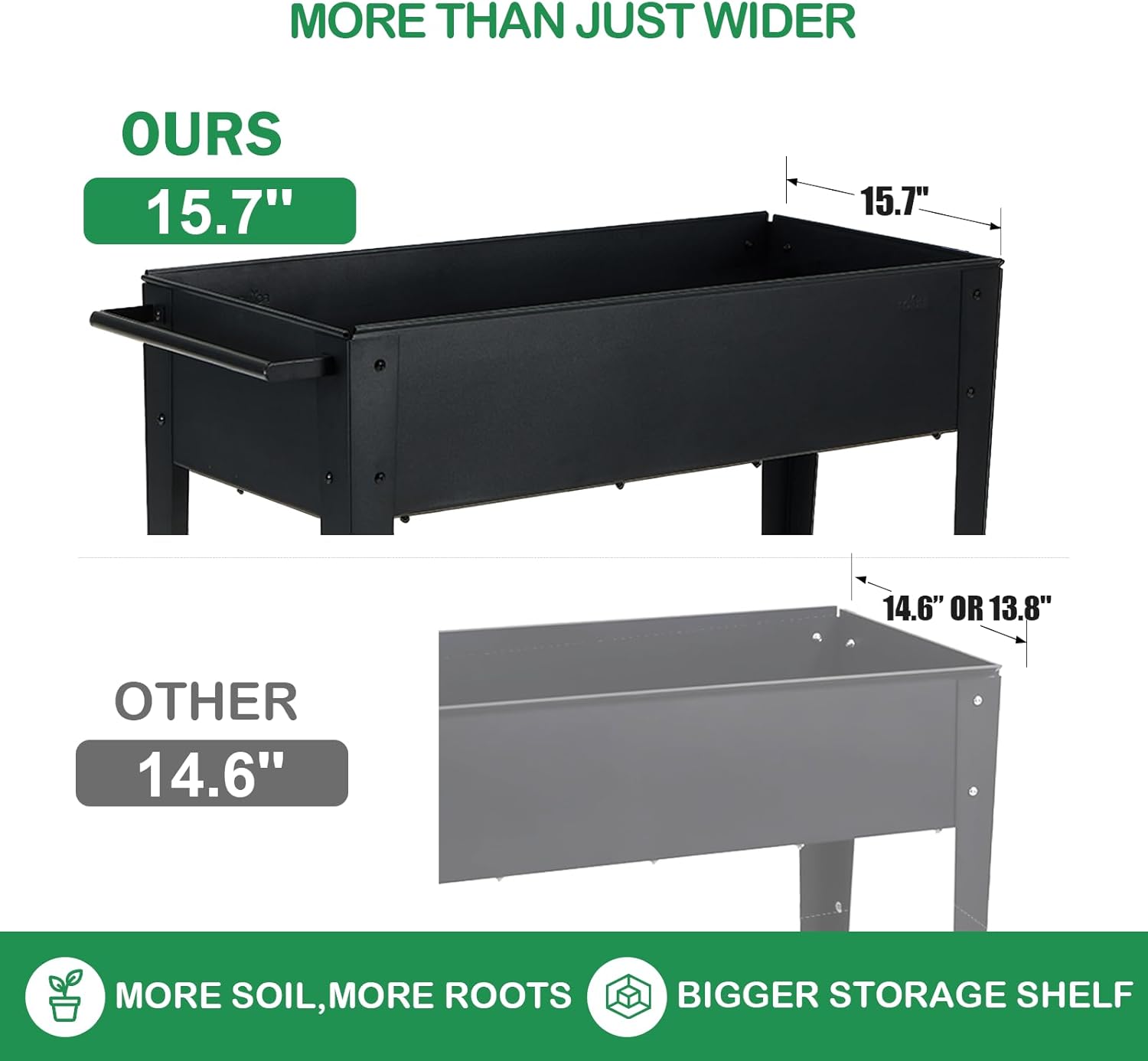
31.5"
$69.82
In stock on Amazon
Check price on AmazonSolid-Bottom with Drain Holes
Solid-bottom with drain holes is the more common and more problematic configuration. The issue isn’t the holes themselves — it’s what happens when legs elevate the planter off the ground and soil particles gradually migrate into and plug those holes. Fine Gardening’s editorial coverage of container drainage, available at finegardening.com, points out that plugged drain holes in an elevated planter are actually harder to identify and clear than in a ground-level pot, because the visual access angle is poor and the problem often shows up only after root damage has occurred.
What to look for on a spec sheet: drain hole diameter (minimum ¾ inch per hole is a reasonable floor; 1 inch or larger is better), total drain area as a percentage of base area, and whether the manufacturer includes a hardware cloth or mesh liner that prevents soil migration without blocking drainage. When a manufacturer discloses total drainage area in square inches, that’s a sign of engineering transparency worth rewarding.
This configuration dominates the budget tier. It can work acceptably with a lightweight potting mix and attentive maintenance, but it carries meaningful long-term risk in high-moisture climates or with dense amended soils.
DIIYIV 1PCS
$44.09
In stock on Amazon
Check price on AmazonPerimeter-Skirt Designs and Leg Placement
One non-obvious drainage consideration: leg placement determines whether a planter can drain freely when loaded. Four corner legs concentrate the load and leave the center bottom fully exposed — good for drainage. A continuous perimeter skirt with cutout feet blocks lateral airflow and can trap standing water between the skirt and the patio surface.
The Spruce’s container and raised bed gardening editorial guidance at thespruce.com reinforces this point: airflow beneath a planter is nearly as important as the drain hole configuration itself, particularly on impermeable hardscape surfaces like concrete or composite decking. If you’re specifying for a hardscape surface, confirm that the leg footprint allows airflow under the full base area before committing to a skirted design.
Premium-tier planters in architectural steel and Corten materials almost universally use an open four-leg or six-leg frame for this reason — the design is both aesthetically intentional and functionally superior.
MIXC
$79.99
In stock on Amazon
Check price on AmazonWeight Capacity and Structural Math: Don’t Let Wet Soil Surprise You
Soil is heavy. Wet soil is heavier. This is where a lot of practitioners get caught out — the marketed “capacity” on elevated planters almost always refers to the planter’s soil volume in dry quarts or gallons, not its structural weight limit.
The Baseline Weight Math
| Soil Condition | Weight per Cubic Foot |
|---|---|
| Dry potting mix | 25–35 lbs |
| Saturated potting mix | 50–65 lbs |
| Saturated native/loam blend | 75–90 lbs |
A 4-foot × 2-foot × 10-inch deep elevated planter holds roughly 6.7 cubic feet of growing medium. Fill that with saturated native soil and you’re looking at 500–600 pounds of soil load alone — before accounting for the planter itself, plants, or water pooling in a drainage-restricted design.
Most consumer-grade elevated planters with 1-inch galvanized or powder-coated steel legs are rated between 200–400 pounds. That’s fine for a lightweight potting mix kept at moderate moisture, but it’s a structural mismatch for anyone planning to use amended native soil or a heavy compost blend. This Old House’s raised planter construction editorial guidance, available at thisoldhouse.com, recommends verifying that the leg-to-frame connection — typically a welded bracket or bolted collar — is rated independently of the panel material, because the legs may be strong enough while the corner joinery fails first.
Material-Specific Durability by Tier
Budget-Tier: Cedar and Wood Frames
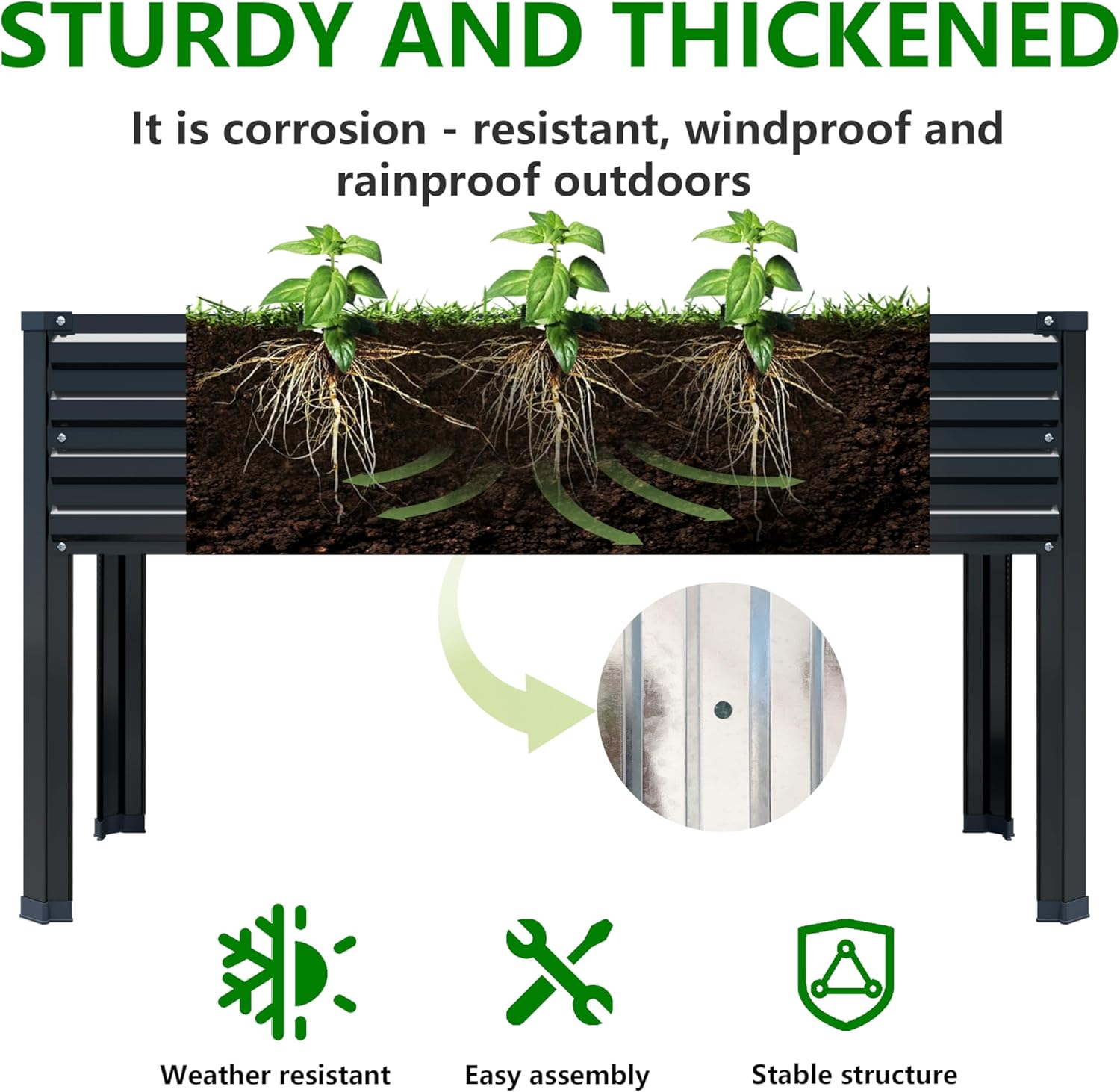
Cedar and redwood frames are naturally rot-resistant but structurally limited — most consumer cedar elevated planters are rated 150–300 lbs. The leg-to-apron joint on wood frames is the primary failure point; mortise-and-tenon or through-bolt joinery outlasts pocket screws by several seasons. Cedar is meaningfully lighter empty than steel or Corten, which matters on deck installs where structural load ratings are a binding constraint. For deck or terrace applications at the budget tier, cedar with a slatted base and verified joinery type is the most defensible specification.
DIIYIV 1PCS
$44.09
In stock on Amazon
Check price on AmazonMid-Tier: Powder-Coated Steel and Composite Frames
Powder-coated steel frames carry the highest load ratings in the mid-tier category, typically 400–600 lbs depending on leg gauge. They are susceptible to rust at coating nicks in high-moisture environments; look for a minimum 60-micron powder coat thickness in product specification documentation. Composite panels — recycled HDPE or wood-plastic composite — resist rot and moisture cycling well, but composite is not well-suited to long unsupported spans. Better Homes & Gardens editorial coverage at bhg.com on container garden design specifically recommends a center support rail on any composite planter wider than 36 inches to prevent mid-span deflection under soil load.
31.5"
$69.82
In stock on Amazon
Check price on AmazonPremium-Tier: Corten and Architectural Weathering Steel
Corten and weathering steel planters develop a stable oxide patina that protects the substrate without paint or coating maintenance. Manufacturer-rated loads are typically high — 400 lbs and above — and the frames are engineered for multi-season outdoor exposure without refinishing. The trade-off is initial weight: a 48-inch Corten planter frame can weigh 60–80 lbs empty, so factor assembly and delivery logistics into commercial installs. For design-forward residential and institutional projects where longevity and aesthetics both matter, this tier justifies the premium clearly.
MIXC
$79.99
In stock on Amazon
Check price on AmazonPatio surface load distribution note: An elevated planter concentrates soil weight onto four or six leg contact points rather than distributing it across the full base footprint. On pavers or composite decking, this creates point loads that can crack a paver or compress a deck joist. For any planter exceeding 300 lbs loaded weight, specify rubber or HDPE leg pads and verify the deck structure’s point-load rating against the original deck specification, or route the calculation through your structural contact.
Accessibility Height: The Numbers That Actually Matter
This is the section where practitioners most often over-simplify. “Accessible” gets used loosely to mean “easier to reach from a standing position.” But if you are specifying for a client with genuine mobility limitations — or for any commercial or institutional property where ADA compliance is relevant — the numbers are specific and non-negotiable.
ADA reach-range standards per the U.S. Department of Justice, 2010 ADA Standards for Accessible Design, Section 4.2:
- Side reach maximum: 54 inches above the floor
- Forward reach maximum (unobstructed): 48 inches above the floor
- Forward reach maximum (over an obstruction): 44 inches above the floor when the obstruction depth is 10–24 inches
For a wheelchair user approaching a planter from the side, the growing surface — the soil line — should ideally sit at or below 30–34 inches for comfortable working depth. High enough to eliminate bending, low enough for full-arm reach across the growing area. The ADA standards set the ceiling; the 28–34 inch range represents the functional sweet spot confirmed across accessible garden design resources published by the Cornell Garden-Based Learning program and referenced in adaptive gardening programming.
Practical height comparison for common elevated planter configurations:
| Planter Height (to soil line) | Best Use Case |
|---|---|
| 24 inches | Standing users reducing bending; marginal for seated access |
| 28–32 inches | Wheelchair-accessible sweet spot; usable by most standing adults |
| 36 inches | Optimal for tall standing users; requires forward-reach clearance review for seated users |
Knee clearance matters as much as height. For a wheelchair user to pull up to the planter and reach across it, there needs to be a clear knee space underneath — minimum 27 inches high, 30 inches wide, and 19 inches deep per the 2010 ADA Standards. Open-leg planter designs (four corner legs with no apron or skirt) generally satisfy this automatically. Skirted designs with a solid lower panel almost never do. If a client is asking for both an aesthetic planter and an accessible one, open-steel-frame or elevated Corten designs satisfy both requirements more cleanly than solid-wood skirted designs — a point reinforced by The Spruce’s accessible garden design editorial coverage at thespruce.com.
The Decision Framework: If X, Then Y
After working through drainage architecture, structural math, and accessibility standards, most specifications resolve cleanly.
If the primary use case is accessibility for a mobility-impaired user: Specify a 28–32 inch working height, open-leg frame (not skirted), with minimum 27-inch knee clearance. Prefer composite or powder-coated steel over wood — wood frames at this height frequently require an apron that closes off knee clearance.
If the primary use case is a design-forward residential install with no accessibility requirement: Height is an aesthetic choice in the 30–36 inch range. Prioritize drainage architecture — slatted or open-bottom frame over solid-panel-with-holes. Corten or architectural powder-coat finishes justify the premium because they hold up without maintenance cycles.
If weight is a real constraint (deck install, second-story terrace, pavers): Specify lightweight potting mix only, calculate loaded weight before purchasing, and verify leg-pad or foot-plate coverage to distribute point loads. Cedar or composite panels are meaningfully lighter than steel or Corten empty.
If the client wants to use native or heavily amended soil: Only specify steel-frame elevated planters rated 500 lbs or higher. Slatted base required — solid-bottom designs will fail under the drainage burden of dense soil. Budget for this tier from the outset.
If budget is the binding constraint: The drainage gap between a slatted-bottom elevated planter and a solid-bottom one matters more than the material upgrade. A lower-cost cedar planter with a slatted base will outperform a pricier composite planter with plugged drain holes every single growing season. Start with drainage, then material, then aesthetics.
Frame joinery type, drain hole total area, knee clearance dimension, and loaded weight rating are the four numbers that separate a confident specification from a return shipment. Ask for them before you buy.