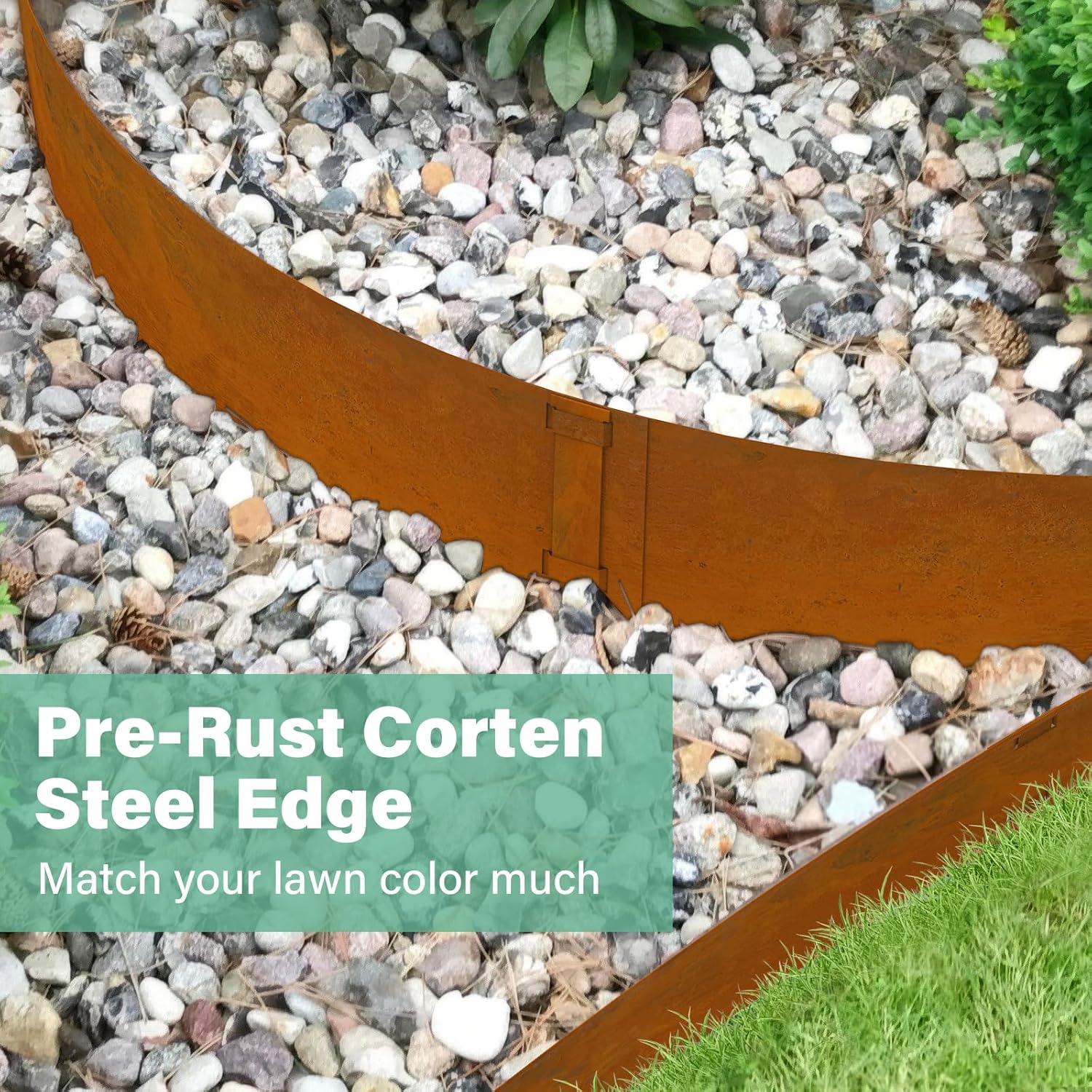
You just specced out a multi-bed vegetable garden or a sloped front planting strip, and now you’re looking at steel edging options and running into a choice the product listings don’t explain well: 4-inch or 6-inch depth is the common retail default, but 8-inch and 10-inch “tall” profiles exist — and for certain applications, the shallower stuff will fail you within a season. Steel landscape edging is exactly what it sounds like: thin strips of steel (or occasionally aluminum or Cor-Ten weathering steel) hammered into the soil to create a clean, durable border between a planting bed and a lawn, path, or gravel zone. The depth — how far below grade the edging runs — is the spec most buyers overlook. This article is specifically for situations where depth matters: raised-bed containment, sloped terrain, and root barriers against aggressive plants. If you’re one of those situations, you need to understand what the extra 2–4 inches of steel actually buys you, and where it costs you more than it’s worth.
| EDITOR'S PICK[Co rten Steel Landscape Edging…](https://www.amazon.com/dp/B0D12G3JDY?tag=greenflower20-20) | Mid-tier[Corten Steel Edging Steel Lands…](https://www.amazon.com/dp/B0D7M2PM5G?tag=greenflower20-20) | Budget pickSteel Landscape Edging 40" Lx8 H | |
|---|---|---|---|
| Height | 10" | 8" | 8" |
| Pieces | 6 | 6 | 8 |
| Material | Corten steel | Corten steel | Steel |
| Pre-rusted | ✓ | — | — |
| Stakes incl. | — | — | ✓ |
| Length per pc | — | 40" | 40" |
| Price | $96.99 | $84.99 | $49.99 |
| See on Amazon → | See on Amazon → | See on Amazon → |
Why Depth Matters More Than Gauge on Sloped Sites and Aggressive Root Systems
Gauge — the thickness of the steel itself — gets most of the marketing attention, and it does matter for edge stiffness and long-term rust resistance. But gauge only tells you how rigid and durable the strip is above and at grade. On flat, stable ground with well-behaved plants, 16-gauge steel at 4 inches deep is often sufficient. The moment you introduce two specific variables — grade change or aggressive lateral roots — depth becomes the limiting constraint.
Slope mechanics. On any incline steeper than roughly 5–8%, soil migrates downhill through a combination of water movement and freeze-thaw cycles (the alternate freezing and expanding of soil moisture in cold climates). Standard 4-inch edging has less than 3 inches of embedment below grade after accounting for the visible reveal — that 1-inch strip you see at the surface. On a slope, that’s not enough anchor mass to resist lateral soil pressure after a heavy rain. Owners who install shallow edging on slopes consistently report heaving — the edging tilts outward at the base — within one or two winters. Eight-inch profiles, set with 6–7 inches below grade, give you meaningfully more resistance to that lateral pressure. Ten-inch profiles are used primarily on slopes steeper than 15% or in situations where the edging also functions as a low retaining element — holding back 2–4 inches of amended soil uphill of the strip.
Root barriers. This is where the spec sheet genuinely undersells the depth question. Fine Gardening’s coverage of raised bed containment notes that common aggressive spreaders — running bamboo, mint, bishop’s weed (Aegopodium), and several ornamental grasses — send lateral roots and rhizomes (underground stems that sprout new plants) at depths of 6–18 inches depending on species and soil type. A 4-inch edging strip stops approximately none of them. An 8-inch strip stops the surface-level spreaders but will be bridged by running bamboo, which the University of Maryland Extension explicitly notes requires a minimum 24–30-inch barrier depth for reliable containment. The honest summary: 8-inch steel edging is an effective barrier against mint, bishop’s weed, creeping Jenny, and most ornamental grasses. It is not a bamboo solution — that application requires purpose-built HDPE (high-density polyethylene) root barrier fabric at 24 inches or deeper.
Raised bed containment. Here the calculation is simpler. If your raised bed sits on native soil and you’re importing a premium blended growing mix (typically a combination of compost, topsoil, and aeration amendments like perlite), you need the edging to both contain that mix laterally and prevent grass and weed roots from migrating in from below the bed perimeter. Eight-inch edging with 6 inches below grade does this reliably. Ten-inch edging is worth the cost premium if the bed is on a slope, if you’re using particularly loose or sandy fill that tends to migrate, or if the bed sits adjacent to a lawn edge where turf runners are a known problem.
The Gauge-and-Depth Matrix: What You’re Actually Comparing
The steel edging market in 2026 clusters around a few standard combinations. The table below is based on published manufacturer specs from the major domestic brands:
| Profile | Typical Gauge | Approx. Price/Linear Ft | Best Use Case |
|---|---|---|---|
| 4” tall, 16-ga | 16 | $1.20–$1.80 | Flat beds, ornamental borders |
| 6” tall, 14-ga | 14 | $1.80–$2.60 | Flat beds, mild slope, grass barrier |
| 8” tall, 14-ga | 14 | $2.40–$3.40 | Slopes, root barrier (non-bamboo), raised beds |
| 10” tall, 11-ga | 11 | $3.50–$5.00 | Steep slopes, structural raised beds, retaining edge |
A note on gauge numbering: in steel, lower gauge numbers mean thicker steel. Eleven-gauge steel (approximately 1/8 inch thick) is noticeably stiffer than 16-gauge (approximately 1/16 inch) — you’ll feel the difference when you’re driving stakes. This Old House’s steel edging installation coverage notes that 14-gauge is the practical minimum for any application where the edging must resist lateral soil pressure; 16-gauge is better suited to decorative borders on flat ground.
Cor-Ten steel — a weathering-steel alloy that forms a stable, dark orange-brown oxide patina instead of flaking rust — is available in both 8-inch and 10-inch profiles from specialty suppliers. Gardenista’s coverage of designer metal edging identifies Cor-Ten as the premium choice for exposed applications where appearance is part of the design intent. Expect to pay a 30–60% premium over standard mild steel at equivalent gauge. The tradeoff: Cor-Ten requires no painting or coating and the patina is genuinely attractive; mild steel in painted or galvanized form is more cost-effective but will eventually require touch-up on cut edges and stake penetration points.
Installation Realities the Product Pages Don’t Mention
Stake spacing on slopes. On flat ground, stake spacing of 24–36 inches is standard for 14-gauge edging. On slopes, The Spruce’s landscape edging coverage recommends tightening stake spacing to 12–18 inches and using longer stakes — 12-inch stakes instead of the standard 8-inch — to compensate for the reduced horizontal resistance from the soil. With 10-inch edging on steep slopes, this means your stake cost is roughly double what it would be on flat ground. Factor that into your material estimate before you commit.
Seam connectors matter more at depth. Eight-inch and 10-inch edging sections are heavier and have more soil contact area, which means any seam connector that fails transmits that failure across a longer length of edge. The standard friction-fit or overlap-tab connectors that come with budget edging are adequate on flat installations but frequently reported as a weak point on sloped sites by contractors in long-run project reviews. Look for edging systems that offer a locking stake-through connector — a connector that gets pinned by the same stake that anchors the edging itself. EverEdge’s connector system, for example, uses this approach and is consistently cited in practitioner reviews as one of the more reliable seam solutions at the deeper profile sizes.
Soil type and installation difficulty. Ten-inch edging in rocky or heavily compacted clay soil is a genuine installation challenge. The additional depth means you’re driving the edging into a zone where most yards have substantial resistance. Owners report that a rubber mallet and installation board (a scrap of 2x4 to spread the force across the top of the edging without deforming it) is mandatory, not optional. In very rocky soil, pre-cutting a trench with a flat spade or renting a mechanical edger becomes necessary. Budget the labor time accordingly — installation of 10-inch edging in difficult soil runs approximately 2–3x longer per linear foot than 4-inch edging in loam.
Freeze-thaw in cold climates. In USDA hardiness zones 5 and colder, heaving (the upward displacement of edging caused by soil moisture freezing and expanding) is a documented failure mode even for deeply set edging. The mitigation is not more depth — it’s appropriate stake depth and, on raised beds, ensuring the bed perimeter is well-drained so that soil moisture doesn’t saturate the zone immediately adjacent to the edging. Fine Gardening’s raised bed coverage notes that perimeter drainage is as important as edging depth for long-term stability in freeze-thaw climates.
When to Choose 8-Inch vs. 10-Inch: The Decision Frame
Here’s the clearest way to think through the choice:
Choose 8-inch (14-gauge) if:
- Your slope is under 15% grade (roughly 1.5 feet of rise per 10 feet of run)
- Your root barrier target is mint, ornamental grass, creeping groundcover — not running bamboo
- Your raised bed is on relatively flat ground with moderate fill depth (6–12 inches of imported soil)
- Budget is a constraint — 8-inch gives you 80–90% of the performance at a meaningfully lower price per linear foot
Choose 10-inch (11-gauge) if:
- Slope exceeds 15% or you need the edging to also function as a low retaining element
- You’re building permanent raised beds intended to last 15+ years with premium soil mixes
- The site has aggressive lateral-rooting plants other than bamboo (bamboo needs a dedicated root barrier system regardless)
- The installation is a client-facing project where material failure has reputational and warranty implications
The bamboo exception: Neither 8-inch nor 10-inch steel edging is the right tool for running bamboo containment. Per University of Maryland Extension guidance on invasive plant root management, the only reliable in-ground barrier for running bamboo is a purpose-built HDPE barrier at a minimum of 24 inches depth with sections overlapped and taped. Specifying steel edging as a bamboo barrier to a client is a liability exposure — document this clearly if the site has existing bamboo or the client plans to install it.
The math that closes the decision: On a 120-linear-foot raised bed perimeter, the cost difference between 8-inch and 10-inch edging runs approximately $132–$192 in materials (using mid-range price-per-linear-foot figures). On a client install that’s a small delta relative to total project cost. On a DIY personal project, it’s worth asking whether the site conditions genuinely require 10-inch. Most residential raised beds on modest slopes do not. Most root barrier applications for common spreaders do not. Save the 10-inch spec for the sites that actually need it — and when those sites show up, don’t try to save money by going shallower.