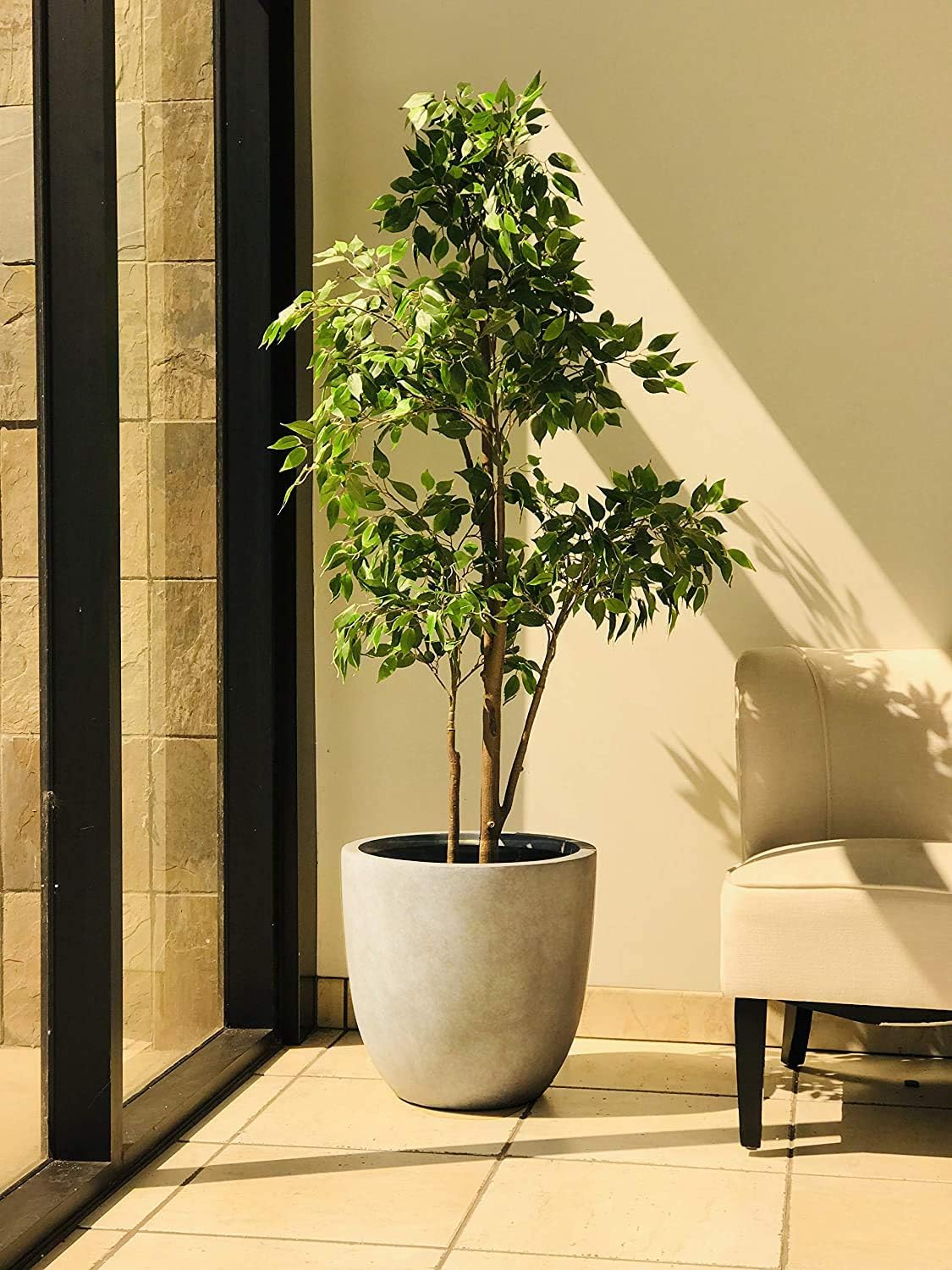
You just spec’d out a stunning concrete-look planter for a client’s front entry — 24 inches wide, tapered silhouette, matte charcoal finish. It photographs like a design magazine spread. Then you flip it over, find a sticker that says “for decorative indoor/outdoor use” with no further detail, and you’re left wondering: will this thing crack in half after the first freeze cycle, or fade to a chalky gray by August? That’s the exact gap this article closes.
“Decorative resin planter” is a catch-all label for containers made from molded plastic polymers — usually polyethylene, polypropylene, or fiberglass-reinforced resin — engineered to mimic heavier materials like concrete, stone, or terracotta. The category spans an enormous quality range, and the difference between a planter that lasts eight seasons and one that fails in eighteen months lives in three measurable specs: wall thickness, UV stabilization rating, and freeze-thaw material classification. Understanding those three numbers — and knowing which brands publish them versus which ones don’t — is the practitioner edge that keeps your installs looking good at the two-year follow-up photo.
Why “Looks Like Concrete” Tells You Almost Nothing About Durability
The surface texture is a mold decision. The durability is a materials decision. Those two choices are made independently by the manufacturer, which is why a $49 big-box planter and a $280 Veradek Metallic Series planter can look nearly identical in a product photo and perform completely differently in the field.
The three variables that actually govern performance:
1. Wall thickness. Measured in millimeters at the thinnest point (usually the upper rim or a sidewall mid-section). Thicker walls resist cracking under root pressure, resist impact damage during install, and — critically for cold climates — have more structural mass to absorb the expansion stress when trapped moisture freezes inside the wall material itself. Industry consensus, reflected in Fine Gardening’s overview of outdoor container durability by climate zone, is that outdoor-rated resin planters in freeze-thaw zones should have a minimum wall thickness of 5mm at the rim, with 7–10mm preferred for planters over 18 inches in diameter.
2. UV stabilization rating. Ultraviolet light degrades polymers by breaking molecular chains — what you see as fading, chalking, or surface cracking is the visible symptom of that degradation. Manufacturers counter it by compounding UV stabilizers (typically hindered amine light stabilizers, or HALS) into the resin at the mixing stage. The ASTM International standard D4329 defines accelerated UV exposure test protocols for plastics; a product citing D4329 compliance — and publishing the number of hours rated — is giving you a real, auditable data point. A product that just says “UV resistant” is giving you marketing copy.
3. Freeze-thaw classification. Some resins are formulated to remain flexible at low temperatures (down to -20°F or lower); others become brittle below 32°F and will crack under load. This is separate from the wall thickness question — a thick-walled planter made from the wrong polymer will still crack in a Zone 4 winter. Manufacturers targeting the cold-climate market explicitly call out the minimum temperature rating on spec sheets. If that number isn’t published, treat the planter as decorative-season-only.
Reading the Spec Sheet: What Each Number Actually Means for Your Install
Here’s where practitioner instinct matters. Most spec sheets for this category are written for retail display, not specification work. You have to know which fields are load-bearing and which are filler.
The fields worth your time:
-
Material designation. “Polyethylene” (PE), “polypropylene” (PP), “high-density polyethylene” (HDPE), or “fiberglass reinforced resin” — these tell you different things. HDPE is the workhorse: chemical-resistant, impact-resistant, and the most widely cold-rated polymer in this category. PP is lighter but becomes brittle faster at low temps. Fiberglass-reinforced resin is dimensionally stable and premium, but heavier and more expensive. When a spec sheet says only “resin” or “plastic,” that’s a data gap, not a specification.
-
ASTM D4329 hours rating. A rating of 1,000 hours of accelerated UV exposure is a minimum baseline for outdoor-rated product. Serious outdoor planters targeting full-sun installations should target 2,000 hours or above. Veradek’s published specification sheets for their Metallic and Woodgrain Series cite UV ratings in this range and list HDPE as the primary material — which is why that product line appears consistently in specification lists for commercial and high-end residential installs.
-
Drainage hole configuration. Not just whether drainage exists, but hole diameter and placement. A 1-inch center drain is inadequate for any pot over 14 inches in diameter in a heavy-rain climate; you want multiple holes or a minimum 1.5-inch aperture, with the hole positioned at the true base of the interior (not recessed behind a structural lip that creates a standing-water zone).
-
Weight (empty vs. filled estimate). For rooftop, deck, or balcony installs, the filled weight calculation is load-bearing (literally). A 24-inch planter filled with standard potting mix runs roughly 80–120 lbs depending on mix density. Add irrigation moisture and you’re closer to 120–150 lbs. If a client’s deck has a 40 lb/sq ft live load rating and you’re clustering three planters, you need to do that math before the install, not after.
By the numbers — quick wall-thickness and UV decision frame:
| Use Case | Min. Wall Thickness | UV Hours Target | Polymer Minimum |
|---|---|---|---|
| Decorative indoor / patio seasonal | 3–4 mm | 500 hrs | PP acceptable |
| Full-sun outdoor, warm climate | 5–6 mm | 1,000–1,500 hrs | HDPE preferred |
| Freeze-thaw zone (Zones 3–6) | 7–10 mm | 1,500–2,000 hrs | HDPE or fiberglass |
| Rooftop / deck structural install | 7+ mm | 2,000 hrs | Fiberglass or HDPE |
Brand-Level Patterns: Who Publishes Real Specs vs. Who Doesn’t
Across the mid-to-premium segment as of mid-2026, spec transparency breaks into roughly three tiers.
Transparent and specification-ready: Veradek and Crescent Garden both publish material designations, UV ratings, and temperature thresholds on their product pages and downloadable spec sheets. Crescent Garden’s technical overview for the TruDrop self-watering system includes polymer sourcing detail and a minimum temperature rating of -20°F for their outdoor-rated lines — the kind of number that converts directly into a climate zone recommendation for your client. Gardenista’s long-form evaluations of large outdoor planters have consistently flagged Veradek and Crescent Garden as among the few brands that actually document performance parameters rather than relying on aesthetic photography alone.
Partial disclosure: Several mid-market brands — in the $60–$150 range — will publish material type but omit UV hours and temperature ratings. This Old House’s buyer guidance on outdoor planter materials notes that “UV resistant” without a test standard citation is effectively unverifiable as a consumer claim. For these products, practitioner-level due diligence means calling the manufacturer directly and asking for the ASTM D4329 test result. If they can’t produce one, you’ve answered your own question.
No disclosure: The entry-level and mass-market segment largely skips spec documentation entirely. That’s a legitimate choice for a homeowner buying a single seasonal container; it’s a risk vector for a designer specifying fifteen units for a commercial property. The failure mode isn’t just aesthetic — a cracked planter on a client’s front walk at month fourteen is a conversation you don’t want to have.
One practical shortcut: the product weight itself is a proxy signal. Genuinely thick-walled HDPE planters in the 18–24 inch range will run 8–15 lbs empty. If a 20-inch planter ships at 3 lbs, the wall thickness is self-evidently on the thin end. That’s not a scientific test — it’s just physics.
The Cold-Climate Decision Framework (and the Warm-Climate Counterpart)
For Zone 3–6 buyers (hard winters, freeze-thaw cycles):
The failure mode is hydrostatic cracking: water infiltrates micro-pores in the pot wall, freezes, expands roughly 9% by volume, and splits the wall from the inside. This happens even in “waterproof” polymer planters if the material has stress micro-fractures from UV degradation. The compounding risk is that UV damage accumulates first, then freeze-thaw exploits the weakened wall structure.
Decision rule: If the planter will overwinter outdoors in Zone 5 or colder, require a documented minimum temperature rating of -20°F, wall thickness of 7mm+, and HDPE or fiberglass material designation. No exceptions for aesthetics. A planter that cracks in year two costs more than the price differential between a marginal product and a cold-rated one.
For clients insisting on a specific aesthetic that isn’t available in cold-rated materials, the correct answer is: bring the planter in for winter storage, or switch to an actual concrete or cast-stone product that handles freeze-thaw natively (at the cost of weight and price).
For Zone 8–10 buyers (minimal frost, intense UV load):
The failure mode flips. Freeze-thaw is largely irrelevant; UV degradation is the primary durability driver. Chalking, color shift, and surface brittleness appear in under-rated planters within two to three seasons of full-sun exposure in climates like Phoenix, Miami, or coastal Southern California.
Decision rule: In high-UV climates, prioritize UV hours rating over wall thickness. A 5mm wall with a 2,000-hour D4329 rating will outlast a 9mm wall with no disclosed UV rating in a Zone 9 full-sun install. Look for pigments listed as UV-stabilized separately from the polymer compound — double-layered stabilization (in both the base resin and the colorant) is the gold standard for color retention.
The If-X-Then-Y Decision Rules
After reviewing published specifications across the category and aggregating owner feedback patterns documented in Gardenista’s and Fine Gardening’s long-form coverage:
-
If your install is Zone 5 or colder, outdoors year-round: Require HDPE or fiberglass, wall thickness 7mm+, published -20°F temperature rating. Veradek’s outdoor-rated lines and Crescent Garden’s documented cold-climate products are the safest spec-ready choices in the $150–$400 price band.
-
If your install is Zone 8–10, full-sun exposure: Prioritize ASTM D4329 compliance at 1,500+ hours. Weight the UV rating more heavily than wall thickness in your comparison.
-
If the spec sheet doesn’t list material type, UV hours, or temperature rating: Treat the product as seasonal or indoor. Don’t specify it for a permanent install without a direct confirmation from the manufacturer.
-
If a client wants to minimize weight for a rooftop or elevated deck application: HDPE resin is the right material class — lighter than fiberglass, dramatically lighter than genuine concrete-look cast stone — but confirm the deck load rating before finalizing planter count and soil volume.
-
If you’re working with a partial-disclosure brand and the aesthetic is strong: Call the manufacturer, ask specifically for the ASTM D4329 test hours and the minimum service temperature, and document the response in your project file. That conversation either surfaces the data you need or tells you the product isn’t specification-ready.
The resin planter category is genuinely good for permanent installs when you’re working with transparent brands and verified specs. The gap isn’t in the materials — HDPE is a proven outdoor polymer — it’s in the documentation. Practitioners who know which questions to ask before the purchase order close faster, specify more confidently, and spend a lot less time managing year-two client callbacks.